During the Middle Ages Who Held the Majority of People Who Read and Write
Medieval literature is defined broadly as any work written in Latin or the vernacular between c. 476-1500 CE, including philosophy, religious treatises, legal texts, besides as works of the imagination. More narrowly, however, the term applies to literary works of poetry, drama, romance, epic prose, and histories written in the colloquial (though some histories were in Latin). While information technology may seem odd to detect histories included with forms of fiction, it should be remembered that many 'histories' of the Center Ages contain elements of myth, fable, and legend and, in some cases, were largely the production of imaginative writers.
Linguistic communication & Audience
Literary works were originally composed in Latin, but poets began writing in vernacular (the common language of the people) as early at the 7th century CE. Vernacular literature was further popularized in United kingdom in the Kingdom of Wessex past Alfred the Bang-up (r. 871-899 CE) in an effort to encourage widespread literacy, and other nations and so followed suit.
Medieval vernacular literature evolved from the folktale, probably with the storyteller interim out different parts, earlier an audition.
The Norman Conquest of 1066 CE established French as the language of literature and transformed the English language from Old English (in utilise c. 500-1100 CE) to Center English (c. 1100-1500 CE). The stories written during both these eras were originally medieval folklore, tales transmitted orally, and since most of the population was illiterate, books connected to be read out loud to an audience. The aural attribute of literature, therefore, affected the way information technology was composed. Writers wrote for a performance of their work, not a individual reading in solitude.
Literacy rates rose during the 15th century, and with the development of the printing press, more than books became bachelor. The human action of reading by i'southward self for personal pleasure became more common and this inverse the way writers wrote. Thomas Malory's Le Morte D'Arthur (written 1469, published 1485 CE) is the earliest novel in the west – a work written for an private audience with layers of personal meaning and symbolism – and lay the foundation for the evolution of the novel as recognized in the nowadays day.
Early Development
Medieval vernacular literature evolved naturally from the folktale which was a story recited, probably with the storyteller acting out different parts, before an audition. Medieval English literature begins with Beowulf (7th-10th century CE) which was no doubt a story known much earlier and transmitted orally until written downwards. This same pattern of evolution holds for the literature of other countries too. The storyteller would assemble an audition and perform his or her tale, usually with variations based on the audience, and members of that audition would so retell the story to others.
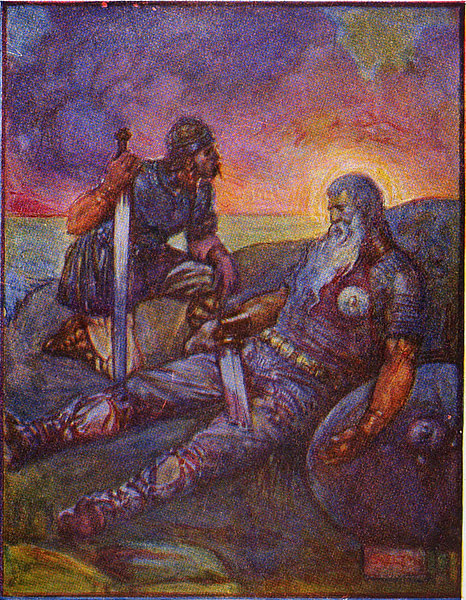
Wiglaf & Beowulf
Early written medieval literature is mostly legend or folktale set down on a page rather than recited only the storyteller still needed to gather and agree an audience and then wrote in the vernacular to be understood and in poetic meter to exist remembered. Poetry, with its regular cadence, sticks in the mind far meliorate than prose. Poetry would remain the preferred medium for artistic expression throughout nigh of the Middle Ages. Latin prose, except in some outstanding cases, was reserved for religious and scholarly audiences. For entertainment and escape from 1's daily life, people listened to a storyteller read from a skilful book of verse. Lyric poesy, ballads, and hymns were poesy, of course, just the great chivalric romances of courtly dearest and the loftier medieval dream vision genres were also written in verse as were epics, and the French and Breton lais (short-story poems).
Initially, medieval writers were anonymous scribes setting downwards stories they had heard. Originality in writing in the Middle Ages (as in the ancient world) was not loftier on the list of cultural values and early writers did non carp to sign their works. The actual names of many of the most famous writers of the Middle Ages are yet unknown. Marie de France is not the actual name of the woman who wrote the famous lais – it is a pen name – and Chretien de Troyes' proper name translates from the French equally "a Christian of Troyes" which could refer to almost anyone. It was not until the 13th and 14th centuries CE that authors began writing nether their own names. Whether known or anonymous, notwithstanding, these writers created some of the greatest works of literature in history.
Other Forms of Literature
Other forms of literature besides poetry included:
- drama
- histories
- fables.
Drama in the Middle Ages was essentially a instruction tool of the Church. Morality plays, mystery plays, and liturgical plays all instructed an illiterate audience in acceptable idea and behavior. Passion plays, reenacting the suffering, crucifixion, and resurrection of Jesus Christ, were popular Easter entertainments but morality plays were presented year-round. The best-known of these is Everyman (c. 1495 CE), which tells the story of a man facing death who cannot find anyone to accompany him to heaven except his practiced deeds. This allegory grew out of an earlier Latin type of literature known as the ars moriendi (art of dying) which instructed people on how to live a proficient life and be assured of heaven.
Histories in the Early Middle Ages (476-grand CE) oft rely on fable and myth to circular out and develop their stories. The works of historians such as Gildas (500-570 CE), Bede (673-735 CE), and Nennius (9th century CE) in Britain all contain mythic elements and repeat fables equally fact. The well-nigh famous example of this is Geoffrey of Monmouth's History of the Kings of United kingdom (1136 CE) written in Latin. Geoffrey claimed to be translating an aboriginal historical work he recently discovered when in fact he was making nearly of his 'history' up out of his own imagination and pieces in older actual histories which lent themselves to the tale he wanted to tell. His one thousand vision of the early kings of Great britain focuses largely on the story of the heroic Arthur and it is for this reason that Geoffrey of Monmouth is recognized as the Begetter of the Arthurian Fable.
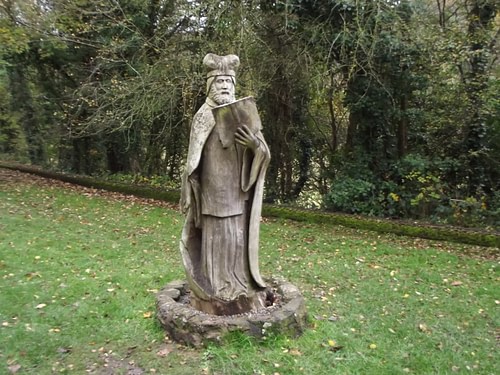
Geoffrey of Monmouth
Fables almost e'er featured anthropomorphized animals as characters in relaying some moral lesson, satirizing some aspect of humanity, or encouraging a standard of beliefs. The most popular and influential cycle of fables were those featuring Reynard the Trick (twelfth century CE onwards) whose adventures frequently brought him into conflict with Isengrim the Wolf. Reynard is a trickster who relies on his wits to go him out of trouble or to gain some reward.
In i tale, How Reynard Fought Isengrim the Wolf, Isengrim challenges Reynard to a fight to the death to win the favor of the rex. Reynard knows he cannot win but also cannot refuse so he asks his aunt for help. She shaves off all his fur and coats him in slick fat and he winds up winning because the wolf cannot get concur of him. The fable ends with Reynard being commended past the king. As with about fables, the underdog comes out a winner against overwhelming odds, and this theme fabricated the tales of Reynard the Fox, and other similar characters, immensely pop.
Poetic Forms & Famous Works
Withal, the most popular and influential works were the stories told in verse. The earliest poem in English whose writer is known is Caedmon's Hymn (7th century CE) which is a simple hymn praising God equanimous by an illiterate shepherd who heard it sung to him in a vision. His song was written downward in Old English by an unnamed scribe at Whitby Abbey, Northumbria and kickoff recorded in the writings of Bede. The simple beauty of this early verse became the standard of Sometime English poetry and axiomatic in works like The Dream of the Rood (a 7th-century CE dream vision) and later The Battle of Maldon (late tenth century CE).
Between these two works, the epic masterpiece Beowulf was written, which relies on the same cadence of the alliterative long line rhythm to move the story forward and impress the tale upon an audience. This poetry grade resonates in the present twenty-four hour period equally well as it must accept in the past since recitations and performances of Beowulf remain pop. The story is the epic tale of the lone hero facing down and defeating the nighttime monster that threatens the people of the state; a theme perennially popular from ancient times to the present day.
Chretien's poems about the damsel in distress & the brave knight became quite popular & contributed to the development of the legend of King Arthur.
A afterward French work, The Song of Roland (11th century CE), is another epic which explores the same theme. In the French work, however, the 'monster' is given the homo form of the Saracens threatening Christian lives and culture. Roland, the not bad knight of Charlemagne, is finally called upon to concord the laissez passer of Roncevaux against the advancing enemy and gives his life to protect his rex, country, and comrades from the invaders. The poem was and then popular it is said to have been sung by the Norman troops at the Battle of Hastings in 1066 CE to boost morale.
Romances, which became quite popular with the European elite, began to flourish in the twelfth century CE in southern France. Chretien de Troyes (l. c. 1130-c.1190 CE), poet of the court of Marie de Champagne (l. 1145-1198 CE) is the best known of the romantic poets and certainly among the most influential. Chretien's poems about the damsel in distress and the brave knight who must rescue her became quite pop and contributed to the development of the legend of Male monarch Arthur and his Knights of the Round Tabular array, which would finally exist fully realized by Malory.
The romance genre, whether given in poetry or prose, relies on the audience's acceptance of the concept that true dearest tin can never concluding or is unattainable. At the cease of the story, ane or both of the lovers die or must part. The concept of a happily-ever-after ending, popular in medieval folklore, rarely concludes a written medieval romance. According to some scholars, this is because the romantic literature of courtly love was a cleverly coded 'scripture' of the Cathars, a heretic religious sect persecuted by the medieval Church. The Cathars ("pure ones" from the Greek Cathari) claimed they were the true faith and worshipped a goddess named Sophia (wisdom) who bore a number of similarities to the Virgin Mary.
According to the scholarly theory regarding the Cathars and the medieval romance, the dryad in distress is Sophia and the brave knight is the Cathar adherent who must protect her from danger (the Church). Two of the well-nigh powerful women of the Middle Ages, Marie de Champagne and her female parent Eleanor of Aquitaine (fifty. c. 1122-1204 CE) were both associated with the Cathar heresy and both patronesses of writers of the romances such as Chretien de Troyes, Andreas Cappelanus, and most probable Marie de France, then in that location is some historical support for the theory.
Whether the romances were allegorical works, their elevation of women in the fictive worlds of the chivalric hero influenced the way women were perceived – at least in the upper classes – in everyday life. The genre was developed further in the 12th and 13th centuries CE by poets such every bit Robert de Boron, Beroul, and Thomas of Britain, and the great German language artists Wolfram von Eschenbach (l. 1170-1220 CE) and Gottried von Strassburg (c. 1210 CE), who all contributed significant aspects to the Arthurian fable.
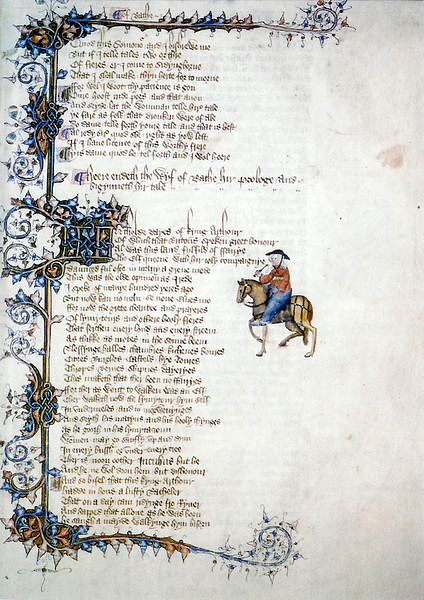
Canterbury Tales
By the time of the 14th century CE, even so, the medieval view of adult female-equally-property had been largely replaced past the novel concept of woman-as-individual famously exemplified past Geoffrey Chaucer in the character of the Married woman of Bath in The Canterbury Tales. Women appear in Chretien's works as strong individuals in the 12th century CE – about famously the grapheme of Guinevere in the poem Lancelot or the Knight of the Cart – but the Married woman of Bath is much more than rounded and complete individual who owes her composition as much to the French fabliaux (a short story told in poesy) as to the romances or figures from folklore.
The acme of womanhood reached its apex in the poetry of Petrarch (l. 1304-1374 CE) whose sonnets to the persona of Laura continue to resonate in the modern day. Petrarch's piece of work was so popular in his time that it influenced social perceptions not only of women but of humanity in general which is why he is oft cited as the outset humanist author.
While the romances entertained and edified, another genre sought to drag and console: the loftier medieval dream vision. Dream visions are poems featuring a first-person narrator who relates a dream which corresponds to some difficulty they are experiencing. The about famous of these is The Pearl past an unknown author, Piers Plowman by William Langland, and Chaucer's Book of the Duchess, all from the 14th century CE. The genre commonly relies on a framing device by which a reader is presented with the narrator's trouble, is then taken into the dream, and is and so brought dorsum again to the narrator's waking life.
In The Pearl, the narrator is grieving the loss of his daughter, has a dream of her new life in heaven where she is condom and happy, and wakes reconciled to the loss of his "precious pearl without a price". The begetter'southward grief is relieved past God allowing him to run across where his daughter has gone and how she has not ceased to exist merely has simply found a new and brighter home. Piers Plowman also reveals the goodness and love of God to the dreamer, a man named Volition, who is taken on a journey in his dreams in which he meets the good plowman, Piers, who represents Christ and who teaches him how to better live his life.
Chaucer'south Book of the Duchess (his get-go major long poem, c. 1370 CE) departs from the religious theme to focus on grief and loss and how 1 lives with information technology. In this work, the narrator's true honey has left him and he has been unable to sleep for years. While reading a book about 2 lovers who have been parted by death, he falls asleep and dreams he meets a black knight in the wood who tells him of his ain true beloved, their happy life together, and finally of his grief: his wife has died. The poem explores a central question of the ladylike love romances: was it better to lose a lover to death or infidelity? The narrator never answers the question. When he wakes from the dream, he tells the reader he was and so amazed past it that he will write information technology downward as a poem; he leaves information technology up to the reader to answer the question.
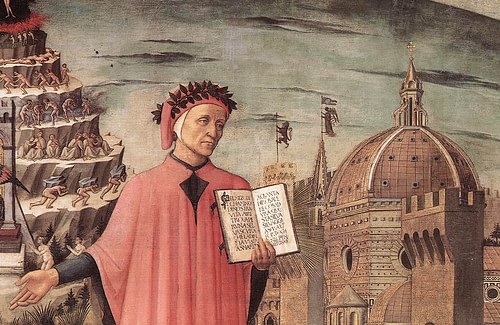
Dante, Florence Cathedral
The medieval dream vision reaches its greatest elevation in Dante Alighieri' s Divine Comedy (14th century CE) in which the poet is taken on a journey through hell, purgatory, and paradise in order to correct the path he was on and clinch him of the truth of the Christian vision. The Divine Comedy is not an actual dream vision – the narrator never claims he has fallen asleep or that the events are a dream – but Dante draws on the trappings of the genre to tell his story. So closely does The Divine One-act mirror the progression, tone, and issue of the loftier medieval dream vision that contemporaries – and even Dante's own son – interpreted the piece as a dream.
Conclusion
Although verse continued every bit a pop medium in the Late Middle Ages, more writers began working in prose and among these were a number of notable women. Female person Christian mystics such as Julian of Norwich (l. 1342-1416 CE) and Catherine of Sienna (50. 1347-1380 CE) both related their visions in prose and Margery Kempe (l. 1373-1438 CE) dictated her revelations to a scribe who recorded them in prose. One of the most famous writers of the Middle Ages, Christine de Pizan (l. 1364-c.1430 CE) wrote her highly influential works in prose as did the great Italian creative person Giovanni Boccaccio (l. 1313-1375 CE) best known for his masterpiece, the Decameron.
The Arthurian Fable, adult from the 12th century CE onwards, was rendered in prose in the Vulgate Cycle between 1215-1235 CE and the edited version known as the Post-Vulgate Cycle (c. 1240-1250 CE) which provided the basis for Malory's work. Malory's Le Morte D'Arthur codified the Arthurian Legend which was then enhanced and reworked by afterward writers and continues to exert influence in the present day.
Although scholars continue to debate precisely which work should be considered the first novel in English, Malory'due south work is always a strong contender. William Caxton, Malory's publisher, was one of the first to do good from the new printing press invented past Johannes Gutenberg c. 1440 CE. Gutenberg's press ensured that medieval literature, largely bearding and free to whomever wanted to publish it, would survive to influence later generations of readers.
This article has been reviewed for accuracy, reliability and adherence to academic standards prior to publication.
Source: https://www.worldhistory.org/Medieval_Literature/
0 Response to "During the Middle Ages Who Held the Majority of People Who Read and Write"
Publicar un comentario