What Do the Vines of Jasmine Symbolize in Inside Out and Back Again
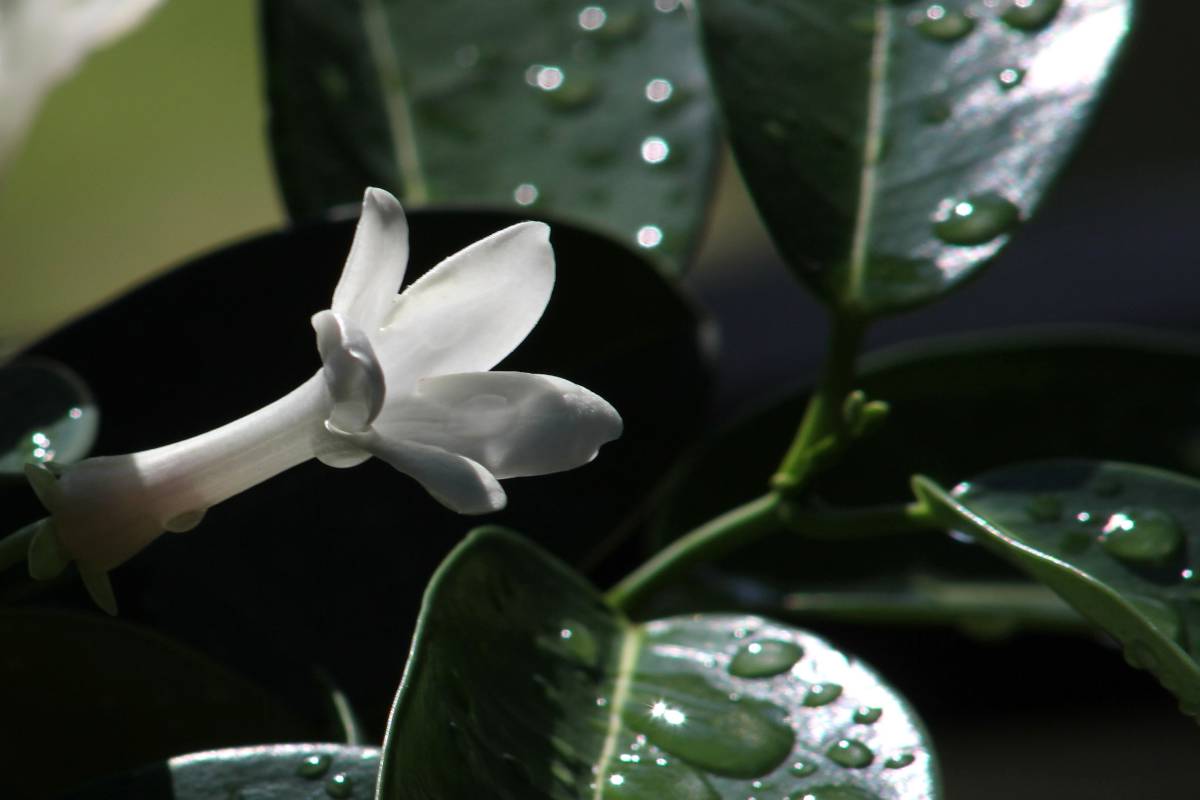
Stephanotis, the most famous of which is called Madagascar jasmine, is a magnificent indoor constitute that blooms all summer long.
Key facts near Stephanotis
Name – Stephanotis species
Family – Apocynceae or dogbane
Type – vine, indoor plant
Superlative – ten to 16 feet (3 to 5 meters)
Exposure – well-lit
Soil – indoor plant soil mix
Foliage – evergreen
Flowering – May to October
Planting stephanotis
In our climates, only potted growing is possible for Stephanotis because it tin't bear the cold. This is truthful for all the species of Stephanotis.
Growing stephanotis in pots
If potted, it is brash to re-pot every ane or 2 years, preferably in leap.
Pots provided upon purchase quickly become too small: re-pot your stephanotis as shortly as their blooming is over.
- Once in identify, avoid irresolute its location considering it hates being transferred from one spot to the side by side.
- Refer to our guidelines on how to repot your stephanotis.
Growing stephanotis outdoors
Stephanotis is native to Republic of madagascar, and therefore requires temperatures of at least 68°F (twenty°C) all yr-round to thrive.
- It'll first dying if temperatures driblet below 55°F (13°C).
When growing direct in the ground, temperatures must exist high in both summer and wintertime and planting is done in spring.
Growing and caring for potted Stephanotis
Cull a very well-lit space for your stephanotis, simply not in directly sunlight backside a window.
- Avoid rut sources such as radiators.
- Protect the institute from direct sunlight during the hotter hours if placed backside a window.
- The temperature must never drop below lx°F (15°C).
Yous can bring your potted Stephanotis outside from late spring to early autumn, keeping an eye on the temperature.
Stephanotis in wintertime
Wintertime care for Stephanotis in a pot
Best is to bring the pot in from the common cold to a lean-in or cool greenhouse.
If your plant customarily lives indoors inside a heated house or apartment, it will appreciate a stage of rest over the winter months in a libation spot instead of the hot, dry indoor air.
Temperatures shouldn't drop below 57°F (xiii°C) for extended periods, and any tour of frost will kill the vine.
Ideally, your Stephanotis will become fallow if you keep it in a 57° to 60°F (thirteen to fifteen°C) range. In winter, water your potted Stephanotis only when the soil is dry out, without adding any fertilizer.
Caring for outdoor Stephanotis in winter
If e'er winter is cold in your expanse (beneath 50°F / 10°C), it'll take a miracle for your Stephanotis to survive.
- The only options to protect your outdoor Stephanotis from the cold is either to uproot your stephanotis to a pot and bring it indoors as described above,
- or, if you've already got the materials at hand, to set up a temporary heated greenhouse around it!
Transferring to a pot is by far the most economical solution. Even so, it's also more difficult when the shrub has grown to several anxiety or more in summit. You'll have to bring the trellis or stake along with the plant and root clump. The bigger the plant, the higher the risk of it dying of transplant shock.
- Ane solution could be to plant your Stephanotis with a pot-in-pot strategy to get in easier to pull out and protect.
The Stephanotis plant will work on renewing its root arrangement during autumn and winter, and it'll exist ready for beingness replanted out in the open come up belatedly spring!
Watering and fertilizing Stephanotis
To bloom well and grow, a Stephanotis plant requires a scrap of care every bit regards watering and fertilizer.
H2o regularly just not besides much, to avoid suffocating roots.
- Watering 1 time a week should be enough.
- Adding liquid flower plant fertilizer every fortnight will raise the blooming and growth.
Your stephanotis will require a lot of moisture because its natural habitat is forest underbrush.
- Spray soft h2o on the leaves oft.
When potted, stephanotis needs a lot of moisture and likes beingness placed on a bed of constantly moist gravel or dirt marbles, since this recreates its natural surroundings.
Stephanotis after flowering
The usual blooming season forStephanotis extends from May to October-Nov.
After blooming, its is best to give your institute a "residue" for information technology to go dormant: place it in a libation but well-lit room.
- Ideal temperatures are around 68 to 70° F (20 to 21° C) in summer and 57 to lx°F (thirteen to 15°C) during the residuum phase (usually winter).
During the dormancy, all addition of nutrients must be stopped, and you should only water if the soil in the pot is dry out.
Pruning stephanotis
Early spring, you can prune the vine without restraint to let information technology grow dorsum even ameliorate and ensure it volition bloom again.
- If the vine is very large, and you wish to reduce information technology in size, it may exist improve to stage the pruning over 2 years
- Learn how to prune stephanotis vine in this article
- You'll have to prune if you desire to transfer a stephanotis indoors in colder climates.
Deadheading Stephanotis
If it's easily accessible, go ahead and remove dead or spent flowers. This will trigger the plant into producing more.
- Deadheading will extend the blooming past a couple weeks or more.
Fruits on Stephanotis
If you don't deadhead, you might discover, unremarkably after several years, a plum-shaped pod growing on your vine.
- This isn't a plant disease or an insect gall – it's a fruit!
The pod of the Stephanotis vine is surprising and its seeds are rather heady…
- Pod on stephanotis
Learn more about stephanotis
The most common species of Stephanotis is Stephanotis floribunda, or Madagascar jasmine. In that country, information technology can exist found outdoors in the wild amidst other plants in woods underbrush. It is used in temperate climates as an indoor plant. Other species are native either to the Caribbean area or to the Far Due east (Japan, Malaysia).
All Stephanotis species odour somewhat of jasmine. Generally, they grow every bit fragrant vines that offer deep night greenish leaves, leathery and shiny. They bloom from spring to fall with flowers that appear at the junction of each leaf.
Commonly, a stake or arbor is provided to assist grow upright, considering the vine cannot stand straight on its own.
Stephanotis shares its fragrance with another plant that is related to information technology: Plumeria. Both boast cute white v-petaled flowers. Their fragrance is heavenly when it spreads through the air!
Issues with your Stephanotis
Insects? Yellow leaves? Sticky gobs forming on leaves? Worse yet – no flowers?
- Read up on dealing with pest, disease, and blooming problems for Stephanotis
Smart tip nigh Stephanotis
Calculation flower plant organic fertilizer will heighten its bloom.
- Read besides: Stephanotis, VIP fragrance
- Astonishing indoor plants, a top selection
Source: https://www.nature-and-garden.com/gardening/stephanotis.html
0 Response to "What Do the Vines of Jasmine Symbolize in Inside Out and Back Again"
Publicar un comentario